Sustainability Store

Showing posts with label aquaponics. Show all posts

Tuesday, July 9, 2013

Aquaponics

Part 1 - What is Aquaponics and How is it Better than Soil Gardening and Hydroponics?

Aquaponics is the union of Hydroponics (growing plants without soil) and Aquaculture (raising fish). The concept dates back thousands of years to ancient Egypt and the Aztecs, who built floating islands for growing crops in canals where they raised fish. Ancient far East cultures, like China and Thailand, raised Koi in their rice paddies. The Creole peoples in the Southern United States introduced Crawfish to their rice paddies because it offered an additional food source for the farmer - a practice that was later picked up in China. What do all of these farming practices have in common? They all use raw marine waste as the sole nutrient source for the plants. When the conditions are right, bacterial cultures convert the raw ammonia waste into Nitrites (Nitrosoma sp. bacteria) then into Nitrates (Nitrospira sp. and Nitrobacter sp. bacteria) which are readily available for plants to use. These same bacteria are responsible for the Nitrogen Cycle in soil, but it is much easier to create the ideal conditions (pH, temperature, available oxygen) for the bacteria in water. While it is possible to measure soil temperature and pH the process is time consuming and you can never be sure that the sample collected for testing represents the whole grow bed. Poorly distributed buffers like limestone can easily create pH hot spots and the shade from the growing plants can fluctuate the soil/root temperatures. Furthermore, oxygen concentration in soil is exceedingly difficult to control. One accidental over-watering can deplete the soil of oxygen, kill off the active bacteria cultures, and drown the plant (plants require oxygen at the roots to exchange nutrients). In aquaponics and hydroponics, the water is heavily aerated (introducing dissolved oxygen) and circulated to ensure a uniform pH and temperature, which can be monitored continuously by digital meters; pH can also be verified using simple aquarium test kits.

In a soil-less grow, nutrients are available as the plants need them. In soil, time-release fertilizers are used to ensure that nutrients are available until the next application. However, these time-release fertilizers often run off during the next rain and are a huge contributor to polluted water supplies. Fertilizers intended for hydroponics should not be used in soil because they will drain off before they even have a chance to be metabolized by the Nitrifying bacteria in the soil. Plants will stress during the "feast or famine" presented by nutrient overdose, followed by zero nutrients until the next watering.

So, by now you may see the benefit of soil-less over soil gardening, but you may be asking "why not hydroponics?" The simple answer... hydroponics nutrients are bottled in a salt form to ensure shelf-life rather than their whole, organic, form. In the absence of oxygen (e.g. a bottle of fertilizer on a shelf), Denitrifying bacteria such as pseudomonas sp., alkaligenes sp., and bacillus sp., would break down whole organic matter and release Nitrogen gas - causing the fertilizer to ferment. To avoid this, fertilizer companies ship only salt-based fertilizers or organic fertilizers with an antimicrobial agent (which also hinders the Nitrifying bacteria in your system when you need it most). Salt-based fertilizers must first be broken down from their salt form before they can be used. Then, these salts accumulate in your system which limits the plants ability to uptake water and nutrients. To combat this, hydroponics growers frequently replace their water - resulting in a costly loss of nutrients, wasted water, and environmental pollution. With this frequent water change, a hearty bacteria culture does not have time to establish. Aquaponics suffers from none of these setbacks, because nutrients are continuously produced fresh and ready for the plants to use. The key is the bacteria culture. Like a fine wine, an aquaponics system needs to age to become established. As the system ages, the bacteria culture grows and becomes more robust. As the bacteria culture grows it is able to process more waste and produce more nutrients... meaning it can support more plants or plants with higher nutrient demands. A well-establish aquaponics system can produce roughly 30% higher yield and 30% faster growth rate than a hydropinics system (which is already 50% faster than soil-based growing).

Food for Thought: The most common fertilizers are potassium nitrate and ammonium nitrate. Both are harmful if swallowed/inhaled/ingested and if they come in contact with skin they should be thoroughly washed away. Both are most commonly made from chemically processed salts extracted from mined minerals. Both are used in making explosives. Both have extensive handling and disposal instructions. Fish poop... well, that's already in the rivers, and as gross as it may sound, is perfectly safe to drink. Which would you rather have traces of in your crops?

Stay Tuned for More Updates! Like. Share. Comment. Post. Whatever you feel is right. More to come soon. Please vote on the poll to the right if this is the section you would like to see expanded next, thanks!

Sunday, April 29, 2012

Barrel Basics

Plastic 55-gallon barrel used as a black soldier fly bin
An excellent staple for many home sustainability projects is the simple 55-gallon barrel. Barrels are also available in smaller sizes, but the 55-gallon, being the largest, is the most versatile and the most bang for your buck. IBC totes (usually 275 gallons) and cisterns (can be several thousand gallons) are available in larger sizes, but these usually cost considerably more. The plastic barrels are the best for sustainability projects because metal can leach minerals into water supplies, is subject to rust and corrosion, and by using plastic you are keeping the plastic out of a landfill, where a metal barrel can be easily recycled.


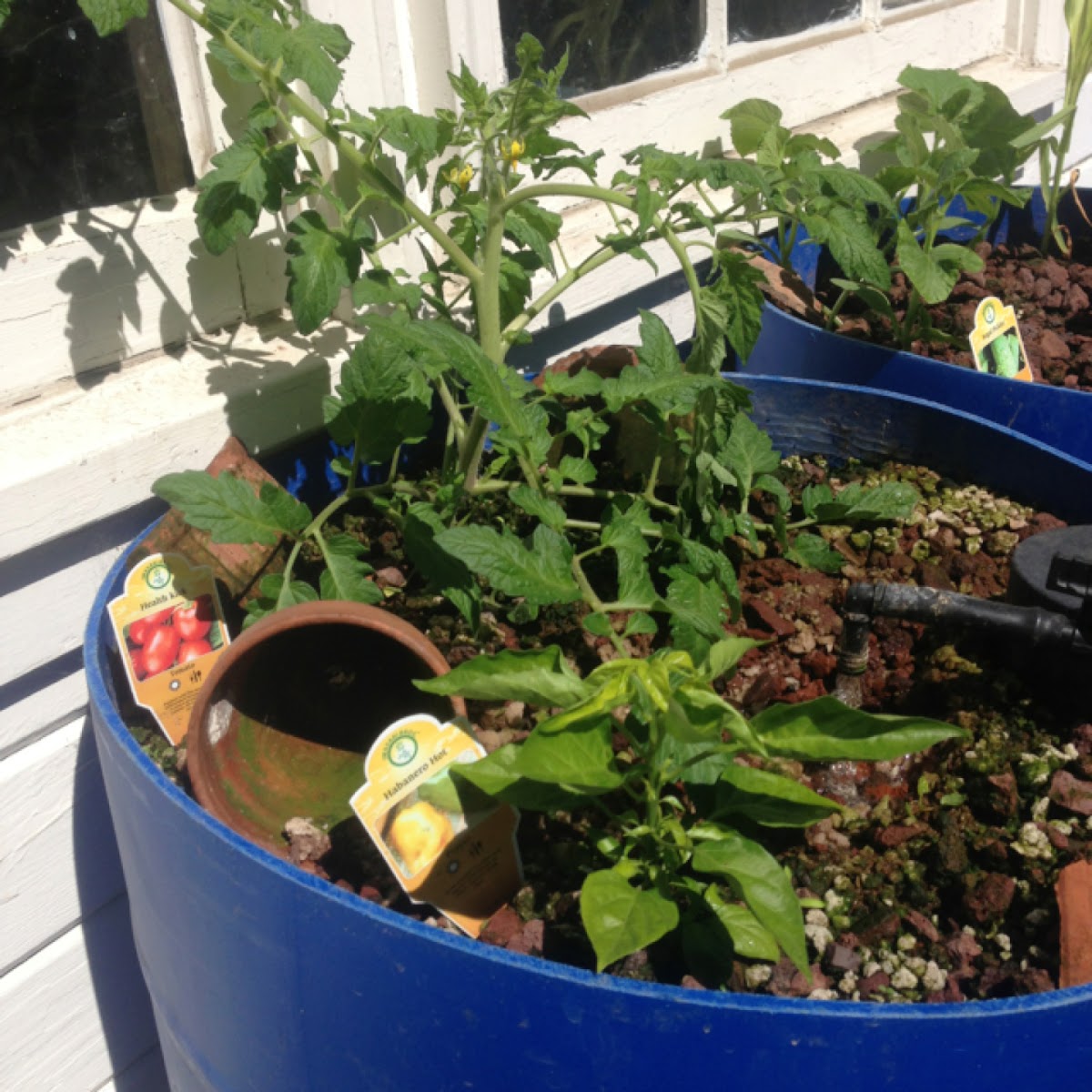
Barrels used in an aquaponics system as a fish tank,
grow beds, and sump tanks
These plastic barrels can be used for many home sustainability projects including rain barrels, aquaponics systems, emergency food storage, manufacturing lye (for homemade soap), manufacturing bio-diesel, raising daphnia and algae (to feed to daphnia), and black soldier fly composting bins. I am even in the process of developing plans to convert a barrel into a wind turbine.
New, these barrels sell for around $175, but they can be found used from home-brew stores, car washes (used to ship soap), bottling companies, as well as Craigslist. Many people (on Craigslist, Farmer's Markets, etc) sell barrels (marketed as rain barrels) fitted with a bulkhead fitting and simple plumbing parts for around $75, but you can easily find raw barrels for $5-$30 on Craigslist and install the plumbing fittings yourself for less than $10 fairly easily. Cheaper barrels on Craigslist are usually not as clean. For example, a barrel may have been used to store used vegetable oil and will have a sticky residue that is difficult to clean out. It is important to ask what was stored in the used barrel, so you can determine if it is too contaminated for your purpose. Also, you will need to decide whether you want open-top barrels (with a removable lid and sealing band), or bung-top. The open top barrels leak when placed on their side or upside down, so they would not be ideal for an aquaponics system (unless you seal them with caulking), but they will be easier to clean out if necessary (for example, if you get algae build up in your rain barrel). Open top barrels are also best for making bio-diesel (ease of stirring), and making lye (ease of adding ash and setting up rock/straw foundation). The bung-top barrels have two holes at the top. One is a buttress thread (not commonly used, the other is a National Pipe Thread (NPT) that is used in PVC pipes. The NPT is a 2" thread that you can easily integrate into piping used in an aquaponics system.
You should also consider the color of the barrel. Plastic barrels come in three colors: black, white, and blue. The black barrels are typically used to ship hazardous chemicals, and the white barrels can attract algae if used for rain barrels because they are slightly transparent. This can be mitigated by painting the barrel. The safest bet is to use the blue barrels.

Uni-Seal used on a black soldier fly bin
When converting a barrel for your desired project, you will need to cut out holes and/or squares and may need to attach pipes through the holes. Squares can be cut easily by drilling holes at the corners of where you want the square with a 2" hole saw and connecting the holes with straight cuts made with a sawzall. This will create nice-looking rounded edges on the cut-out (shown in picture). A hole for a 1" PVC pipe will be drilled with a 1.75" hole saw. To seal the hole the three main methods are: use a barbed fitting (this can be very difficult to get through the hole and may not provide a tight seal), use a bulkhead fitting (pieces inside and outside the barrel thread together with a seal in between, the inner piece can be difficult to place in a barrel with a bung top unless you are cutting out an opening in the barrel), or a Uni-Seal. A Uni-Seal is a compression fitting that goes in the hole and the pipe is slipped through the seal. The Uni-Seal compresses and forms a tight fit without requiring access to the inside of the barrel. A 1" Uni-Seal would be used for a 1.75" hole to allow a 1" pipe to pass through. The picture to the right shows a 2" Uni-Seal on a black soldier fly bin. To slip the pipe through the seal, it is best to file the outside of the pipe that will pass through (so it has a slightly smaller outer diameter) and use a non-toxic pipe grease. Non-toxic is especially important if this is for rain barrels. The dark colored blue barrels usually have a thicker wall, which doesn't allow the Uni-Seal to expand as much, so you may have to use a razor blade to trim the inner portion of the Uni-Seal to allow the pipe to pass through. Just be sure not to trim off too much, so you still have a tight fit. Bulkhead fittings can be found at Lowe's or Home Depot (usually in the electrical section), but Uni-Seals can be harder to track down. So far I have only found them online, see Amazon link below.

With that, you should have a fairly detailed understanding of the type of barrels available and how to select the right barrel for your sustainability project. In future posts I will show more of each type and how I have incorporated their differences into my designs. I hope at this point you're getting excited about becoming self-sufficient and begin looking for a local source for barrels. I'm not sure yet whether I will post next about rain-barrels or black soldier flies. If you have a preference, please vote to the right. Thanks!

Featured Products:

Friday, April 27, 2012

Why Be Sustainable?

I've decided to become completely self-sufficient. Ideally, I would produce everything I use and never have to go to the store again, but there will be some things I cannot produce on my property, like salt. I will work on compiling a list of these items so they can be purchased in bulk.

People often ask me, "why are you doing this?" Why be sustainable? They often have a few ideas in mind, and think that I am motivated by just one reason.  The two common reasons people think of are "preparing for the end of the world" and "going green." Really, it is a combination of these reasons and several others.

Preparing:
It's wise to prepare for the worst. Imagine a natural disaster wipes out crops and there is a food shortage. Record temperatures kill off the tomato crop in Florida. A volcano erupts in the Pacific Northwest that kills off the potato crop in Idaho. An earthquake disrupts freight lines and highways used to ship food all around the country. You get the idea. However, preparing need not center around such extreme scenarios. Imagine, gas prices hit $9.00/gallon and shipping food becomes too expensive. Food prices skyrocket and there is economic collapse leading to looting in grocery stores. In short, if you're not providing for yourself then your food source is at risk.

Saving Money:
Perhaps the crisis you face is not widespread, but more personal. Should you lose your job or become too sick to continue working it would relieve a lot of stress to be able to produce everything you need. Imagine not having an electric bill, a water bill, a grocery bill, a fuel bill. Even if you are healthy and employed, becoming self-sufficient can be a feasible path to early retirement.

Better Food:
Homegrown food, in an aquaponics system for example, is fresher, healthier, and tastes better. Avoid the dyes, preservatives, hormones, chemicals, and pesticides. Food bought from the grocery store is frequently picked early and ripened with ethylene gas while it is in transit. Packaged foods are pumped full of preservatives to improve shelf life. To make a more profitable product, manufactured food is loaded with hormones, dyes, pesticides, herbicides, and other chemicals. "Flavor enhancers" are used because manufacturers know that food that is not as fresh does not taste as good. Know where your food came from. Know your food is clean and safe. Grow your own. Even tap water is treated with chlorine and chloramine, two chemicals used to prevent bacterial growth in the water supply. These chemicals cause no immediate damage, but cause serious damage in the long run. The government agencies charged with assuring food safety don't care about long term effects. They are only concerned with things that make you sick immediately. They are concerned when the liability can be tracked. If you eat tainted meat today and are sick in two days, someone is held accountable, and the tainted meat is removed from the marketplace. Protective measures are put in place. If you drink poisoned water every day and get sick in 10 years it is almost impossible to track the liability and no action is taken.

Save The Environment:
Let's face it - this planet is in trouble, and I for one do not want to contribute to the damage. Maybe I won't make that much of an impact by doing my part, but if I can convince others to do their part, then we can all work together to improve a very bad situation. If you produce everything on your own, then you are helping in so many ways. Eliminate the need to ship food across the country. Eliminate the need for water treatment plants to use harsh chemicals. Produce your own electricity. Eliminate plastic and packaging required to ship goods. Eliminate the use of chemicals used in mass production, that eventually end up in rivers and in the ocean. As a society, we consume much more resources than we can possibly sustain and we are facing an imminent collapse. If every person consumes only what they produce, or even produces more than they can use, then we will be a much more stable society. We could even have enough to share with those who cannot produce for themselves.

These are just a few of the great reasons to becomes self-sustainable, but if for no other reason, do it because it's fun. It's extremely rewarding to create something, to eat a plant that you grew, to learn a new skill and see it in action.

This is my first in this blog and I hope to make many more. I hope this blog will become an excellent resource for anyone wanting to get off the grid and become more sustainable. I have only recently started on this path, but I have already learned so much. I look forward to sharing with you the things I have learned, and I hope you look forward to my updates. I also hope that you will embark on this journey with me. It is not all that complicated, and you too can become completely self-sufficient.